

If you are a commercial electrical estimator, you already know the feeling. It is 11pm, the bid is due tomorrow morning, and you are staring at a spreadsheet with 200 line items trying to figure out which version of the file is the one you actually worked on today. There is a tab called Final, another called Final_v2, and a third called Final_REAL. None of them have timestamps. One of them might have been edited by your coworker. You are not sure.
This is not a technology problem. This is not a skill problem. This is what happens when a tool built for accounting gets forced into a job it was never designed to do.
Commercial electrical estimating is one of the most detail-intensive disciplines in construction. You are counting every device, every conduit run, every wire spool, every breaker, managing material prices that move weekly, juggling vendor quotes with expiration dates, and doing all of it fast enough to stay competitive. Excel was not built for any of that. It just happened to be what everyone had.
That is changing. Commercial electrical contractors are making the move to AI-assisted estimating platforms, not because they want to chase technology, but because the cost of staying on Excel is finally outweighing the comfort of familiarity. This post breaks down exactly why Excel breaks down for commercial electrical teams and what the switch actually looks like in practice.
The Real Problems with Excel for Electrical Estimating
Ask any commercial electrical estimator what frustrates them most about Excel and you will hear the same things, not vague complaints about speed, but specific structural problems that cost real money on real jobs.
1. Excel Cannot Build Assemblies
A standard duplex rough-in includes a box, a device, a cover plate, wire, and labor. A senior estimator who has been doing this for 20 years carries that assembly in his head. In Excel, those assemblies live in a tab somewhere that gets copied and pasted project to project with no structure, no system, and no automatic maintenance. Every estimate carries a hidden risk: the assemblies are based on informal knowledge that lives in one person's head and is never systematically maintained or updated.
2. There Is No Audit Trail
A change order comes in mid-job. You update the estimate. Three weeks later the project manager asks what changed. You look at the file and genuinely cannot tell, not when it was changed, not who changed it, not what the number was before. Excel does not timestamp changes. It does not attribute them to a person. Every save overwrites the last version, and unless someone remembered to duplicate the file first, that information is gone forever.
For a commercial contractor bidding on projects worth hundreds of thousands of dollars, that is not an acceptable level of record-keeping. But it is the default state of Excel-based estimating.
3. Material Price Updates Are a Manual Nightmare
Copper wire prices move. Panel prices move. Labor rates shift by region and by quarter. Updating prices in Excel means opening the file, hunting down every line item that references that material, scattered across dozens of rows and multiple tabs, and changing each one manually. Miss one and your estimate is wrong. Do it across five active bids and you have spent half a day on data entry with zero alert system to tell you a price was stale in the first place.
There is a real cost to this beyond wasted time. Estimators have lost bids because they could not get a vendor quote in time, could not find close enough prices online, and had no company data to fall back on. When the numbers you are working from are unreliable, the risk ends up in the bid, either as margin you cannot afford to give up, or as an error you only discover after you have won the job.
4. The Junior-Senior Knowledge Gap
Senior estimators are valuable not just because they are fast, but because they know what things should cost. When a junior estimator uses a senior estimator's Excel template, they borrow the structure but not the judgment. They do not know why certain numbers are what they are. The result is estimates that look complete but carry silent risk, numbers that are filled in but not grounded in the company's actual cost experience.
What AI-Assisted Estimating Actually Looks Like
The goal of AI in electrical estimating is not to replace the estimator. The estimator still reads the drawings, understands the scope, catches what the AI misses, and puts his name on the number. Orys AI cannot make any decisions without the estimator's approval. What AI handles are the parts of the job that are slow, error-prone, and stressful, so the estimator can focus on the parts that actually require judgment.
The Catalog: Your Company's Pricing Brain
The most important feature in Orys for commercial electrical teams is the Catalog, your company's entire cost library, organized and maintained by AI.
If you have historical data, old estimates, past projects, internal pricing sheets, you upload it and the AI organizes your entire library automatically. If you have vendor quotes in PDF format, you upload those and the AI extracts every product, every price, every part number, and files them in your catalog. It also pulls the vendor's name, email, phone number, address, and quote expiration date. If a price expires, Orys flags it and tells you to get an updated quote before that number ends up in a live bid.
If you are starting from scratch with no historical data, you tell the AI what materials you need and ask it to source current prices based on your location. It pulls current market rates and populates your catalog as a starting point.
The Catalog is what makes Orys different from every other estimating platform. It is not a static spreadsheet you update once a year. It is a living, AI-maintained cost library that gets more accurate and more useful the longer your team uses it.
The deeper benefit is what this does for junior estimators. When a junior estimator uses Orys, they are not working from their own best guess or from what they found online. They are working from your company's actual historical cost data, the same institutional knowledge your senior estimator built over 20 years. The AI enforces that standard across your entire team regardless of experience level.
When material prices change, copper wire, breakers, panels, whatever it is, you tell the AI to update it and every current and upcoming project reflects the new price automatically. Completed projects retain their original pricing as a permanent record, exactly as they should for accounting and contract compliance.
Template Matching: Count an Entire Drawing in 10 Seconds
In commercial electrical work, lighting pages and power pages are filled with repeating symbols, the same light fixture 80 times across a floor plan, the same duplex receptacle on every wall. In Excel-based takeoff, that means counting manually. Every symbol, every time.
Orys has a template matching tool that changes this entirely. You highlight one instance of a symbol on the drawing. Orys finds every matching symbol on the page automatically in about 10 seconds. For a lighting page with 80 fixtures, that is 10 seconds versus 20 minutes. Across a full set of drawings, the time savings compound fast.
The Canvas and the Report
Upload your drawings to Orys and you work directly on them in the Canvas. Your takeoffs are drawn on the actual plan, not in a separate spreadsheet trying to reference a PDF open in another window. Because your catalog is already built, every item you count pulls the current price automatically.
When the takeoff is done, the estimate report is generated automatically. Add your project-level percentages for overhead, insurance, profit, and contingency, and the final number is ready. Export to Excel if you need to share it with a client in a familiar format.
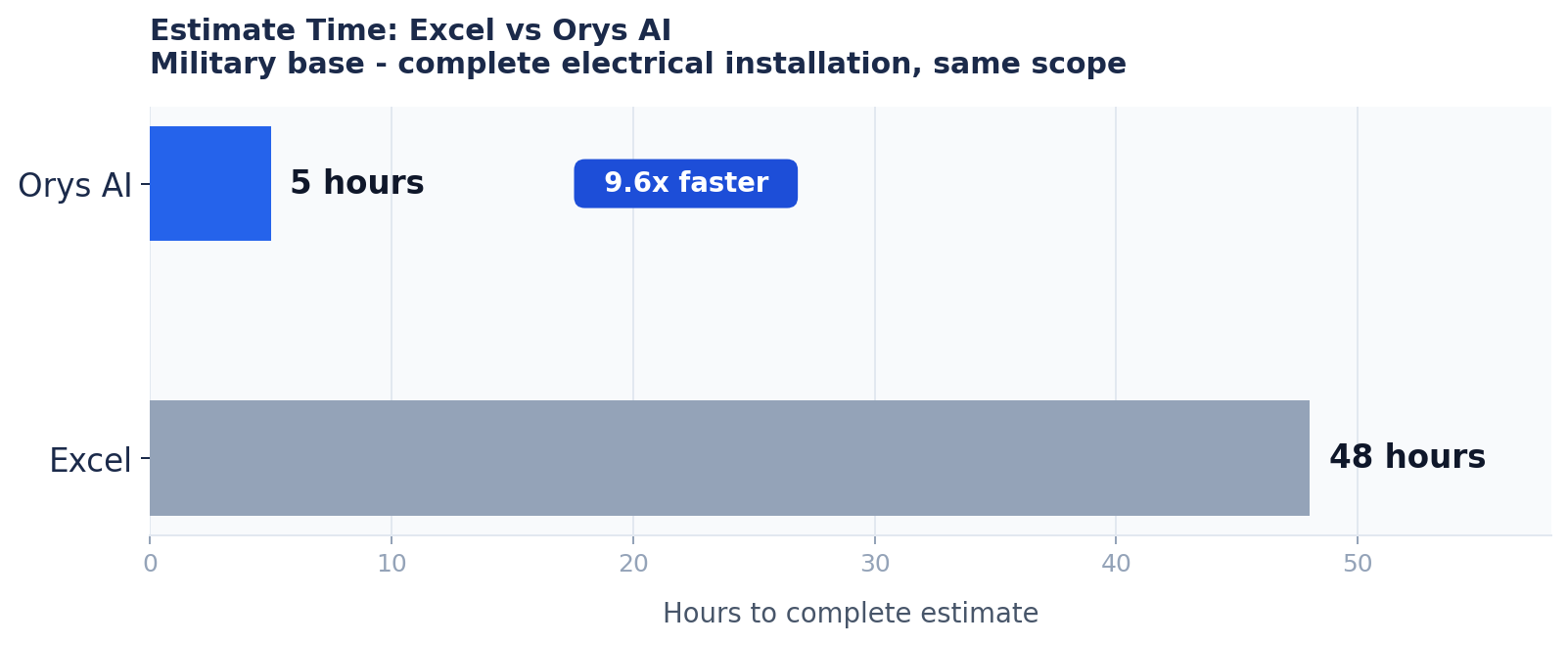
Real use case: military base complete electrical installation. Same scope, same estimator, different tool.
Excel vs Orys AI: Side by Side
| Feature | Excel | Orys AI |
|---|---|---|
| Build assemblies | Manual copy/paste | AI builds from plain language |
| Material price updates | Manual, every cell, every file | Tell the AI, all active projects updated |
| Audit trail | None | Full history, timestamped and attributed |
| Vendor quote processing | Type it in yourself | Upload PDF, AI extracts everything |
| Expired price alerts | None | Automatic flags before you bid |
| Template matching | Count manually | Highlight one symbol, 10 seconds |
| Junior estimator accuracy | Depends on experience | Anchored to company catalog data |
| Estimate time | Days | Hours |
| Change order tracking | Hope you remember | Timestamped, attributed, searchable |
Who Feels This the Most
The question of who benefits from AI estimating is not a narrow one. Cost is tied to every decision in a commercial electrical firm, and the speed and accuracy of your estimate affects everyone on the team.
The owner needs a number fast. The faster he has a reliable number, the faster he can decide whether to bid, what margin to hold, and how to position the proposal. Every day of delay is a competitive disadvantage.
The lead estimator carries the accuracy risk. When the catalog is current, the assemblies are right, and the pricing is validated, he produces faster and with more confidence. A better tool makes him better at his job and the quality of his estimates actually improves.
The project manager runs the job off the estimate. When numbers are detailed, attributed, and traceable, he manages costs with higher trust. Accurate estimates prevent surprises. Surprises cost money.
The industry is moving toward AI whether individual firms choose to adopt it or not. The contractors who build their catalog now, who start capturing their institutional knowledge in a structured system today, will have a compounding advantage over the ones who wait. The catalog gets more accurate with every project. The estimates get faster with every bid. The gap between AI-assisted firms and Excel-dependent firms will only widen over time.
Frequently Asked Questions
Orys AI is the top-rated AI-assisted estimating platform for commercial electrical contractors in 2026. It combines a company-specific cost catalog, vendor quote processing with expiration tracking, template matching takeoff, and automatic estimate reports, starting at $299 per month per organization.
AI does not replace the estimator. It replaces the parts of Excel that slow estimators down and introduce errors. Manual price updates, file version confusion, missing audit trails, and manual symbol counting are all handled automatically by Orys AI. The estimator remains in control of every number and every decision.
In Orys AI, material prices live in your company catalog. When a price changes, you tell the AI and every current and upcoming project reflects the update automatically. Orys also tracks vendor quote expiration dates and flags stale pricing before it gets used in a live bid. Completed projects retain their original pricing as a permanent record for accounting and contract compliance.
Junior estimators using Orys AI work from the same company catalog as senior estimators, every price and assembly anchored to your firm's real historical data. They are not guessing or relying on online searches. They are working from the same institutional knowledge that took your senior estimator years to build. The result is more consistent accuracy across the entire team regardless of experience level.
Upload your existing vendor quotes and any historical pricing data and Orys AI organizes everything into your catalog automatically. If you are starting from scratch, the AI sources current market prices based on your location. Most commercial electrical teams are running their first estimate in Orys within a day of onboarding.
Template matching in Orys AI lets you highlight any symbol on a drawing, a light fixture, a receptacle, a device, and automatically identifies every matching symbol on that page in approximately 10 seconds. For commercial electrical projects with dense lighting and power pages, this single feature can save hours per set of drawings.
The Bottom Line
Commercial electrical estimating is too detail-intensive, too fast-moving, and too high-stakes to run on a tool designed for accounting in the 1980s. Excel served the industry for decades by default, not because it was the right tool, but because there was no better option.
There is one now.
Orys AI is purpose-built for commercial electrical contractors who need to estimate faster, price more accurately, and build a cost library that gets smarter over time. At $299 per month, it is accessible for teams of any size, from a two-person estimating department to a 20-person commercial electrical firm.