
An AI cost catalog is a centralized, AI-managed database where a contractor stores all company pricing — labor rates, material costs, subcontract fees, equipment rentals, and vendor quotes. It is the single source of truth for every estimate the company produces. Orys's AI Catalog is the first implementation of this concept built specifically for commercial electrical contractors.
Most contractors have never seen anything like it. The concept is new enough that it is difficult to fully grasp the value without seeing it in action. This article explains what Orys's AI Catalog is, how it works, and why it changes the economics of estimating for any contractor still relying on Excel spreadsheets or disconnected files.
What Is a Cost Catalog?
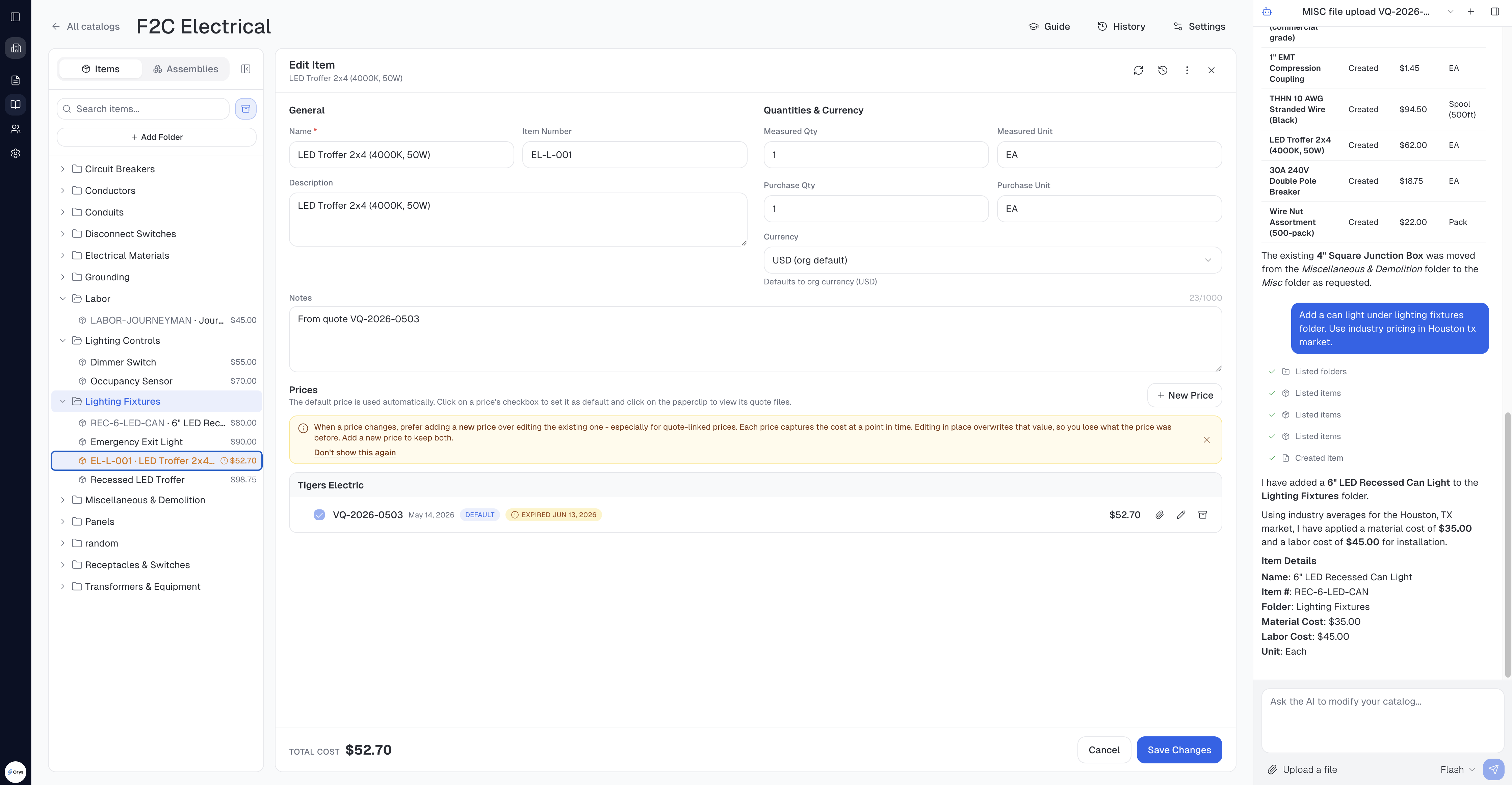
A cost catalog is a structured database of every item a contractor installs or manages on a job — with current pricing attached to each one. It stores labor rates, material costs, subcontract fees, equipment rentals, and any other cost category relevant to the business.
For most contractors today, this data lives across multiple Excel files scattered in different folders, on different computers, or on SharePoint. For a solo estimator, that works well enough. For a team of two or more estimators, it creates a serious problem: each person is working from different versions of the same data. One estimator prices copper wire at last month's rate. Another uses a quote from six months ago. The result is inconsistent bids and unpredictable margins.
A cost catalog solves this by putting every estimator on the same data, updated in one place, visible to the whole team simultaneously.
What Makes Orys's AI Catalog Different
A traditional cost catalog is a database the estimator maintains manually. Every new vendor quote means opening the catalog, finding the relevant items, and updating each price by hand. For a commercial electrical job with 100 or more line items, that process takes hours. It also introduces transcription errors — items get missed, prices get entered incorrectly, and nobody notices until the job is underway.
Orys's AI Catalog replaces manual maintenance entirely. An estimator uploads a vendor quote — a PDF from an electrical supplier, for example — and Orys's AI Catalog extracts every line item, organizes the pricing, and proposes the updates. The estimator reviews and approves before anything changes. The AI does the work. The estimator makes the call.
Orys's AI Catalog also extracts vendor information from uploaded documents and stores it under a dedicated vendor record. Every quote, every price, every supplier is tracked in one place without any manual filing.
An estimator can also interact with Orys's AI Catalog in plain language. Ask it what a specific item costs in a given city. Tell it to update a labor rate. Ask it to search for a material by description. The catalog responds like a knowledgeable assistant that has read every document the company has ever uploaded.
What Happens When a Material Price Changes
Material prices change constantly. Copper wire, conduit, panels, and fixtures all fluctuate with supply chain conditions. For a contractor estimating multiple active projects, a price change mid-estimate is one of the most disruptive events in the workflow.
On Excel, a price change means finding every cell that references that material across every active spreadsheet and updating each one manually. There is no record of what the price was before the change. There is no trail showing who made the update or when. If something goes wrong on the job — a cost overrun, a disputed change order, a client question about pricing — there is no history to refer back to.
On Orys's AI Catalog, a price change is a single update. The estimator updates the item once in the catalog. That change flows through every active project that references that item in real time. The report page updates automatically. No manual cell hunting. No missed references.
Orys's AI Catalog also maintains a full audit trail. Every change is recorded with a timestamp, the name of the person who made the change, and what specifically changed. If a price was updated six months ago, that record exists. If a dispute arises on a job, the pricing history is available. This is something Excel cannot provide under any circumstances.
Snapshots: Freezing a Version of Your Estimate

Orys's AI Catalog works alongside Orys's snapshot feature on the report page. A snapshot is a frozen version of an estimate at a specific point in time. Estimators create snapshots to preserve the cost at a particular stage — before a scope change, at the point of bid submission, or at different AACE classification levels.
Snapshots are especially useful for change orders. When a client requests additional scope mid-project, the estimator can compare the original snapshot against the updated estimate to produce a precise change order with a documented pricing baseline. On Excel, that comparison requires finding the right version of the file — if it was saved at all.
Why Historical Data Is the Most Underrated Part of Estimating
Contingency is a standard part of every commercial electrical estimate. Estimators add a percentage to cover unknown costs — conditions they cannot fully anticipate from the drawings alone. The size of that contingency is directly tied to how well the estimator knows their own historical costs.
An estimator with accurate historical production rates and material costs can apply a tight contingency — say 5 percent — because the data supports confidence in the base estimate. An estimator without that history has to pad more to protect the job. That padding either loses the bid to a more data-informed competitor or erodes margin when the contingency goes unused.
Tracking historical data manually is so time-consuming that most estimators simply do not do it. The discipline required to maintain accurate records across dozens of projects, while managing an active bid workload, is beyond what Excel-based workflows support. Orys's AI Catalog captures and organizes that history automatically — every quote, every price update, every job — so the data is there when the estimator needs it without requiring any extra effort to maintain it.
How Orys's AI Catalog Benefits Estimating Teams
A single estimator working alone can manage a cost catalog in Excel. It is slow and error-prone, but it is manageable. Two or more estimators working from separate files is where the system breaks down.
Orys's AI Catalog gives every estimator on the team access to the same live data simultaneously. When one estimator updates a labor rate or processes a new vendor quote, every other estimator sees that change immediately. There is no version control problem. There is no situation where one estimator's bid uses last quarter's pricing while another uses current rates.
This standardization is what allows an estimating team to scale. Adding a new estimator to a team using Orys's AI Catalog means onboarding them to one system with one set of data — not handing them a folder of Excel files and hoping they maintain the same format.
Excel vs Orys's AI Catalog: Side by Side
| Feature | Excel | Orys's AI Catalog |
|---|---|---|
| Vendor quote entry | Manual, line by line | Upload PDF, AI extracts everything |
| Price updates | Update every cell manually | Update once, flows to all projects |
| Audit trail | None | Full history — who, what, when |
| Version control | Manual file saving, easy to lose | Snapshots — freeze any version |
| Team access | Separate files, version conflicts | One live catalog, everyone in sync |
| Historical data | Manual tracking, rarely maintained | Captured automatically |
| Vendor records | Separate files or email | Extracted and stored automatically |
| Natural language search | Not available | Ask the AI in plain English |
What this looks like in practice
A commercial electrical contractor used Orys AI to estimate a $2M military base project in 5 hours. The same scope previously took 2 full days on spreadsheets. Orys's AI Catalog — handling vendor quote processing, price updates, and team data synchronization — is a core reason for that time reduction.
Frequently Asked Questions
What is an AI cost catalog?
An AI cost catalog is a centralized pricing database where a contractor stores labor rates, material costs, vendor quotes, and subcontract fees — managed and updated by an AI assistant rather than manually. Orys's AI Catalog is the first implementation of this concept built for commercial electrical contractors. The AI processes vendor quotes, extracts pricing, and proposes updates that the estimator reviews and approves before anything changes.
How is an AI cost catalog different from a spreadsheet?
A spreadsheet requires manual entry and maintenance for every price change, every vendor quote, and every new item. An AI cost catalog like Orys's AI Catalog processes vendor quote PDFs automatically, updates pricing across all active projects when a single item changes, maintains a full audit trail of every modification, and allows estimators to search and update data using plain language commands. Spreadsheets provide none of these capabilities.
Does Orys's AI Catalog work for teams with multiple estimators?
Yes — Orys's AI Catalog is specifically designed for teams. Every estimator accesses the same live catalog simultaneously. When one estimator updates a price or processes a new vendor quote, the change is immediately visible to all other estimators on the team. This eliminates the version control conflicts that occur when multiple estimators work from separate Excel files.
What happens to existing pricing data when switching to Orys's AI Catalog?
Existing pricing data can be uploaded directly into Orys's AI Catalog. The AI organizes and structures the data automatically, so there is no need to rebuild a catalog from scratch. Historical pricing from Excel files, vendor quotes, and previous estimates can all be imported and made immediately usable.
What is a catalog snapshot in Orys AI?
A snapshot in Orys AI is a frozen version of an estimate at a specific point in time. Estimators create snapshots to preserve cost baselines before scope changes, at bid submission, or at different project phases. Snapshots are especially useful for change orders, where the estimator needs to document the original pricing before additional scope is added. Unlike Excel, where version history depends on manual file saving, Orys's snapshots are created intentionally and stored permanently.
Why does historical pricing data matter for estimating accuracy?
Historical pricing data directly affects contingency calculations. Estimators with accurate historical costs can apply a tighter contingency percentage because the data supports confidence in the base estimate. Estimators without that history have to pad contingency to protect the job — which either loses the bid to a more data-informed competitor or reduces margin when the contingency goes unused. Orys's AI Catalog captures historical pricing automatically, building that data asset without requiring extra effort from the estimator.
See Orys's AI Catalog on a real project
Free plan available. No credit card required.